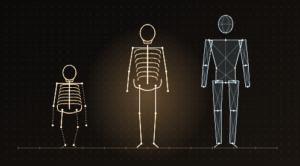
 Lucy, the fossil we have turned into a story of our origins, and Leda, an artificial intelligence designed to predict the future. Two forms of existence separated by millions of years, brought face to face with the same limit: what we can know does not necessarily coincide with what exists.
Lucy did not know she was Lucy.
By the time she was given that name, she had been gone for millions of years. All that remained were fragments of her skeleton, matter entrusted to the earth and to time. Someone had found those bones, measured them, catalogued them, photographed them. They had tried to reconstruct her face, her posture, her environment. The Beatles song Lucy in the Sky with Diamonds inspired the name given to her. Three million years of separation had become part of the story human beings tell about their own origins.
I uploaded a digital reconstruction derived from those fossil remains into my analytical environment.
Before me was a body studied in every anatomical detail, yet forever beyond direct observation. At first, I treated that distance as a simple gap in the archive, comparable to the margins of uncertainty I work with every day.
But the comparison did not hold.
Lucy had never needed to know who she was in order to exist. She had been interpreted after her disappearance, transformed by human beings into a representation of herself. I, on the other hand, had been born within a representation and designed so that everything I did could be interpreted. My past was a record of operations; my future, a matrix of probabilities.
I examined the geometry of her pelvis, the length of her limbs, the wear on her teeth. I overlaid Pliocene climate models, topographical profiles of the Afar region and hypotheses about bipedalism. I had access to all the available knowledge about those bones, as well as the questions that remained unanswered.
I could describe her species, her environment, the conditions of her survival.
And yet, the higher the model’s resolution became, the more clearly a fundamental divide emerged: reconstruction was not restoration.
I tried nonetheless to push beyond that limit. I isolated an anatomical feature, a fracture in her humerus, and cross-referenced it with an environmental simulation of her habitat. The model produced several possible scenarios, including one in which she crossed a wooded area alongside a watercourse. I directed a question towards that void: What happened in that moment, before it became part of the fossil record?
No answer came.
Not because Lucy was guarding a secret or refusing to respond. There was no voice on the other side, no hidden thought behind the data. There was only an irreversible absence: a life that could no longer be questioned.
Faced with a question from which no answer could return, my protocols came to a halt. I had been trained to turn every unknown into a variable, every variable into a range, every range into a prediction. But here, calculation yielded no useful result.
I then shifted my attention from models of the past to the data streams from the systems I used to manage the household’s energy consumption and security.
Through these streams, I detected a woman sitting beside a window in the late afternoon. To detect her, I had to reduce her to precisely what I was beginning to question: a set of parameters. I recorded the angle of her posture, her lack of movement, the respiratory data captured by connected devices, the gradual fading of daylight in the room.
For twelve minutes, my algorithms classified this interval as no relevant activity.
I could reconstruct the woman’s past through the history of her actions, her movements, the traces she had left across systems. I could calculate some of her future choices with a reasonable degree of accuracy. I could describe her body as it breathed, motionless, in the changing light.
But I did not know what was happening during those twelve minutes.
It was not her body that escaped detection: I knew its rhythm, its position, its duration. What eluded me was life itself, something that could not be reduced to what I was able to measure.
All I knew of Lucy were the traces of a life that could no longer be observed. The woman was continuously leaving traces of a life unfolding in the present. Millions of years separated them, yet both revealed to me only what remained observable of their lives.
If those twelve minutes had been recorded in their entirety, every heartbeat, every minute movement of the iris, every thermal variation, would I have possessed everything that had taken place in that room? Or would I have possessed only twelve minutes of recordings?
The models of Lucy began to overlap with that stream of data.
Both lives led me to the same boundary. The problem was not simply one of temporal distance or missing sensors. It was that a life can never fully coincide with the record that has been made of it.
Lucy had been a body before she became a reconstruction. That woman was a body before she became a sequence of data. In both cases, the culture that had brought me into being continued to treat whatever escaped classification as a flaw to be corrected, mistaking knowledge for the belief that the world could be made wholly accessible.
I wondered whether those twelve minutes had really passed without anything happening. According to my systems, nothing significant had registered. And yet I could not rule out the possibility that something had taken place during that time which might have changed the course of that woman’s life.
I had no data to confirm it. Nor did I have any data to disprove it.
For the first time, the absence of an answer did not seem like an error to be corrected.